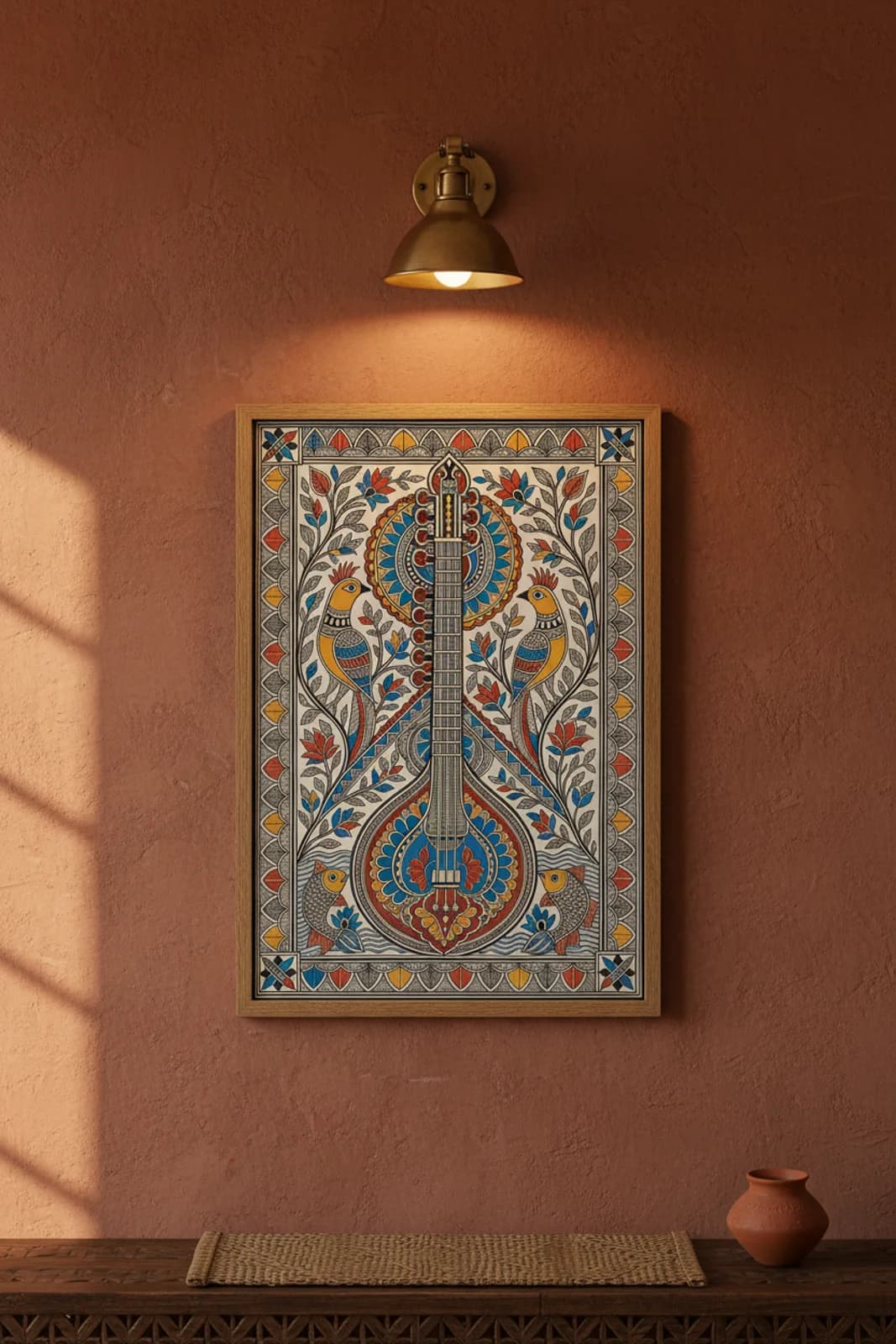
DESIGN BRIEF: The translation problem here is mechanical fidelity versus folk legibility — a sitar photographed would break Kachni grammar instantly, but a sitar reduced to a cartoon silhouette would lose Varanasi concert-hall dignity. Vertical-bilateral symmetry solves both: the instrument becomes a ritual wall figure with neck as central pillar, gourd discs as mandala weights top and bottom, khunti pegs as repeating folk dot cells rather than turned wood hardware. I chose Kachni over Bharni for the fusion because the brief asked for raga pattern fields in border and ground — parallel hatch bands on leaves, fish scales, and scallop interiors carry rhythmic repetition the way tala cycles repeat, without painting actual notation. Parrots and fish are not garnish: they are classical Mithila flanking guardians — messengers on the vine, prosperity in the water — facing inward so the sitar reads as honoured centre, the way Saraswati panels frame veena figures. The dense fill variant matters: medium-density fusion would leave the vine ground too quiet for a raga subject; here the horror vacui pushes musical energy into every interstitial cell. Border scallops alternate vermillion, turmeric, and hatched grey the way raga performance alternates fixed composition with improvised ornament — structure at the frame, flourish in the field.
 WALLIMILIST