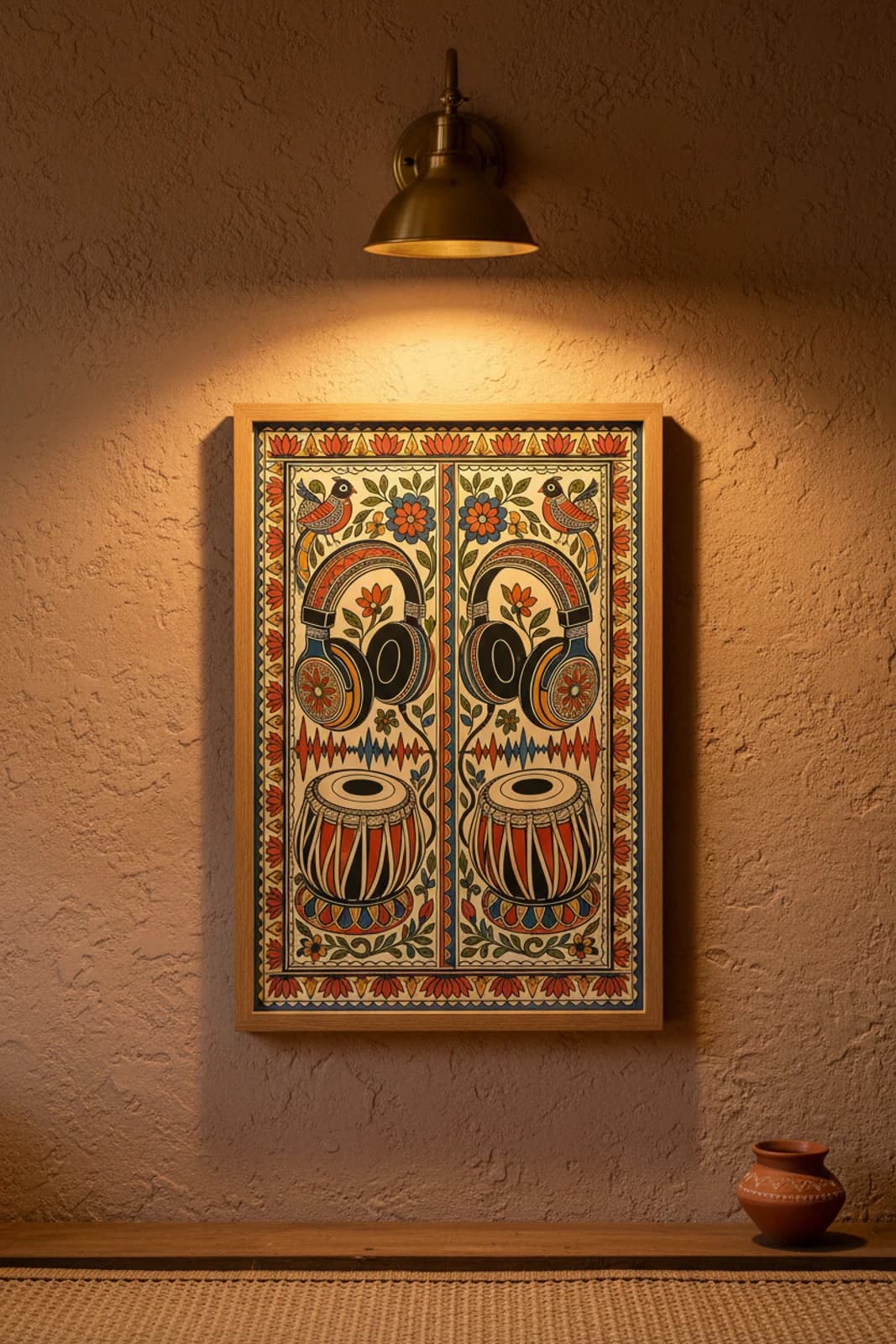
DESIGN BRIEF: the translation problem was acoustic versus digital listening inside north Bihar colour grammar — how do studio headphones and a Hindustani dayan tabla share one Madhubani wall without looking like gadget clipart pasted on wedding paper? Bharni was the right call. Flat vermillion, indigo, orange, and green fills carry the raga palette the catalog brief asked for; bold outlines keep the earcup mandalas and drum syahi legible at poster scale where photographic shading would collapse into mud. Twin-panel-mirror solved the layout: a single headphone stack would float decorative, but mirrored panels with a vertical centre divider give the pair the same bilateral grammar Kohbar walls use for facing musicians — left ear hears tabla, right ear hears the same stack reversed, meeting at the fold like a stereo field drawn in folk contour. The sound-wave zigzags between registers are deliberately naive — red and indigo sawtooth bands, not oscilloscope curves — because Mithila rhythm is pattern repetition, not waveform physics. Corner birds face outward as messengers; lotus border and wavy blue inner band anchor a Delhi fusion subject inside classical floor-and-wall ritual framing. What we simplified: jack plugs, brand marks, finger placement on drum skin. What we kept: striped dayan body, syahi black centre, petal stand, cable vine descent, and mandala-filled earcups that read as folk suns wearing headphones.
 WALLIMILIST