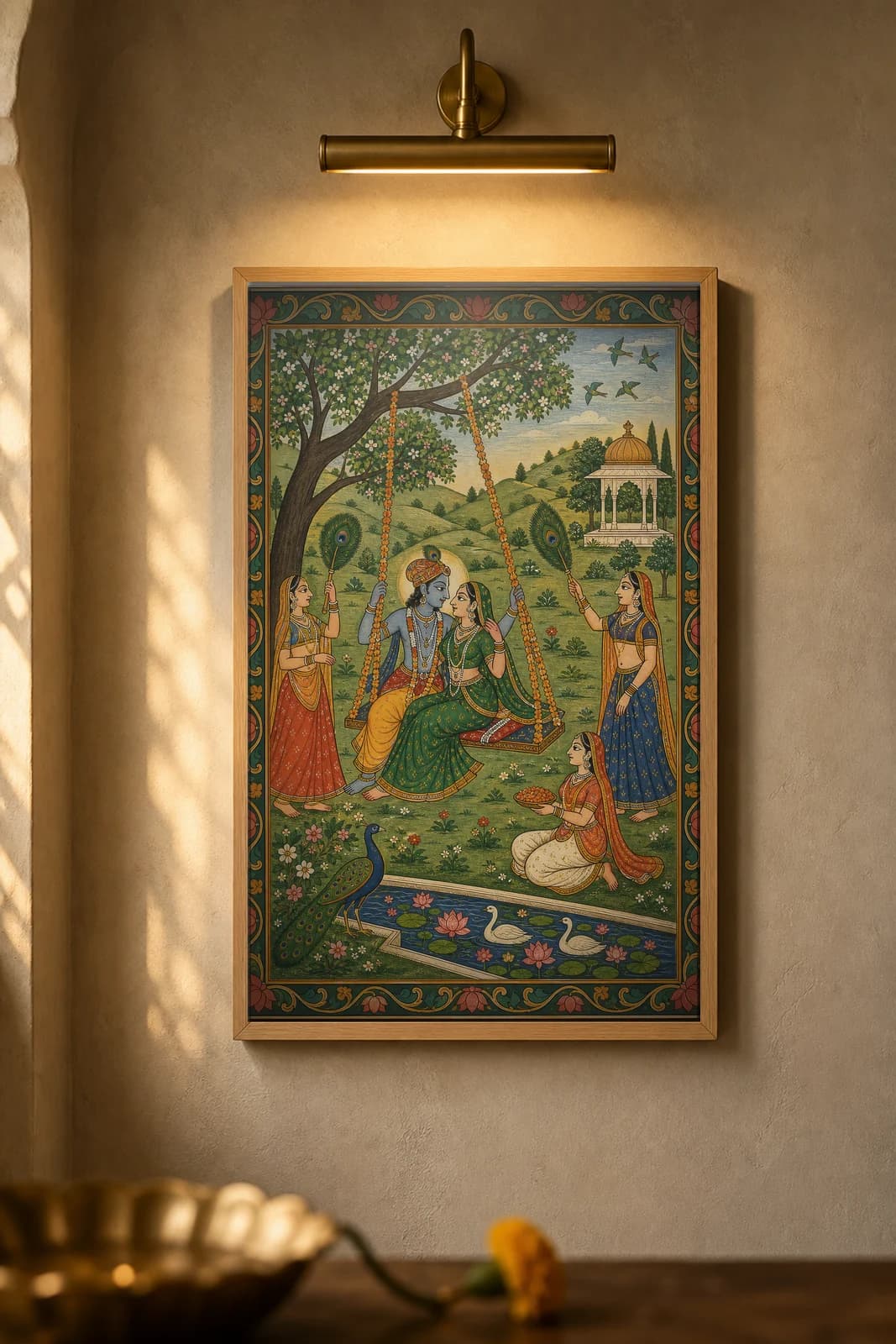
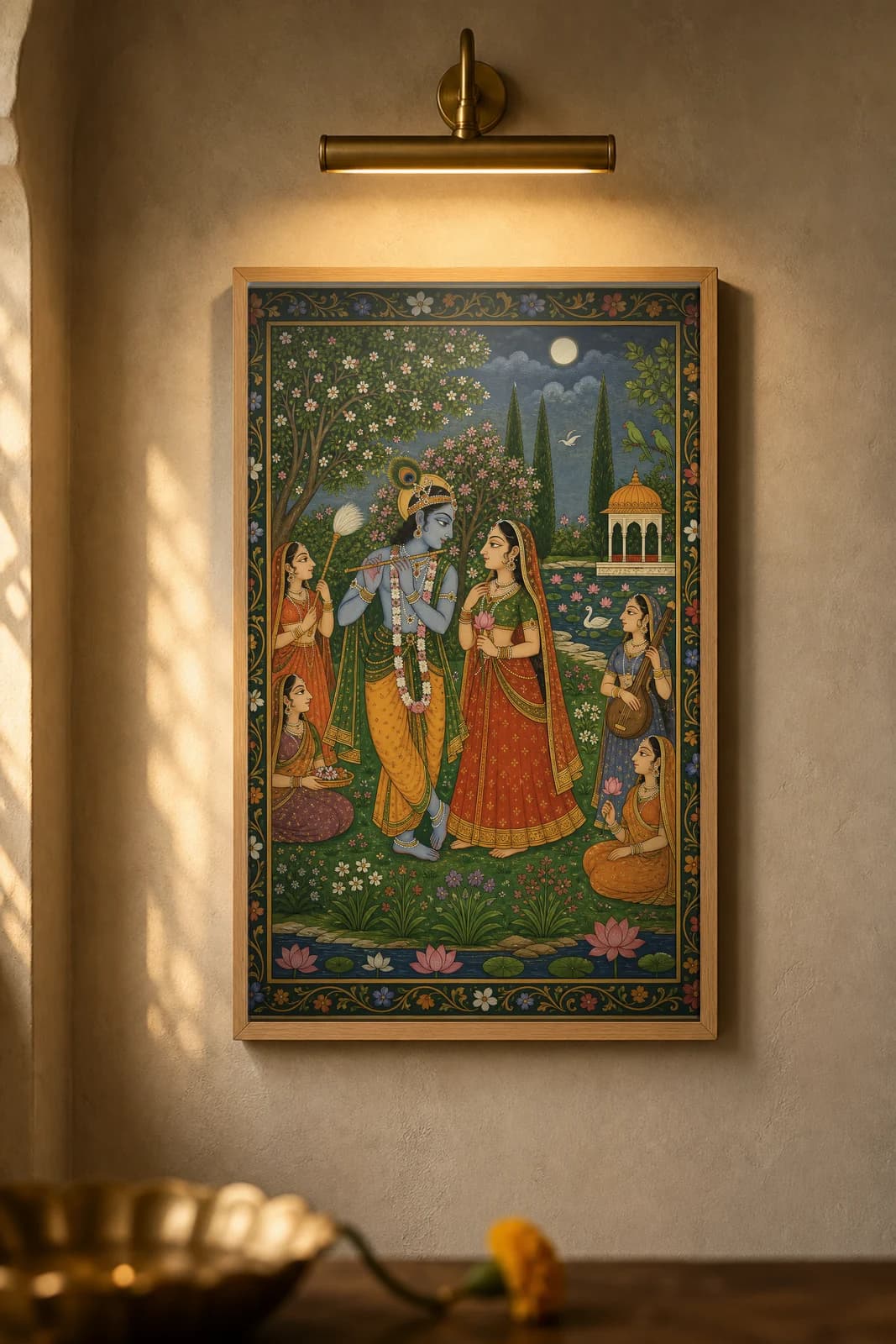
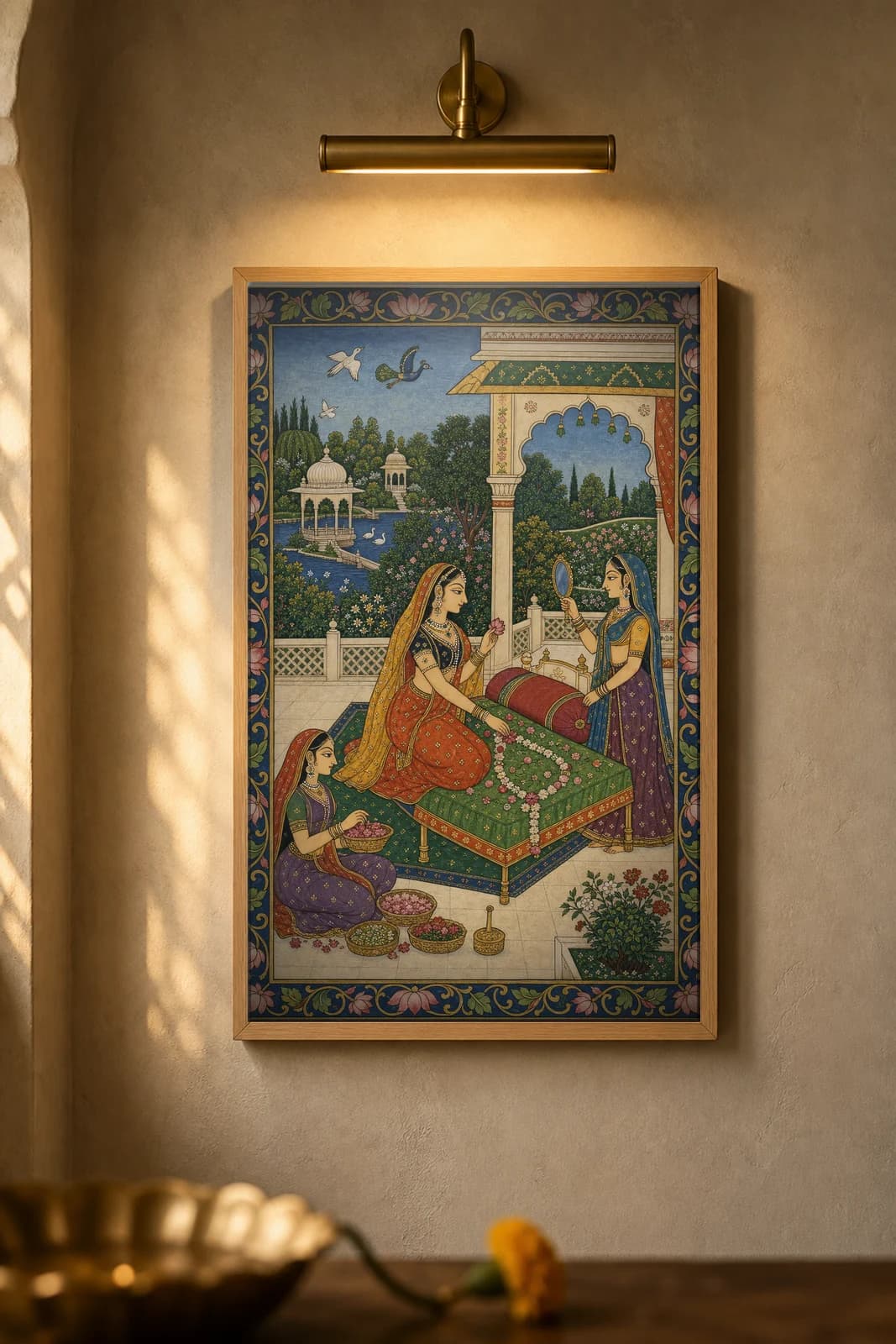
Tender Romantic — 3 museum-grade prints that set the mood. Ragamala ('garland of ragas') painting personifies the musical modes as figures and scenes; Hindola ('swing') is a monsoon raga conventionally shown as lovers — often Krishna and Radha — on a flower-hung swing, linked to the Teej swing-festival of the rains. This treatment follows the Kangra school of the Himachal foothills, which flourished under Raja Sansar Chand in the late 18th and early 19th centuries and is prized within the Rajput miniature umbrella for lyrical naturalism and soft green landscape. Krishna-lila — the love of Krishna and Radha — is the highest devotional and lyrical subject of Rajput and Pahari painting; the Kishangarh school, flourishing in mid-18th-century Rajasthan under Raja Sawant Singh and his painter Nihal Chand, is celebrated for drawing the divine lovers with its idealized profile of the arched eye and fish-curved brow, often in a moonlit bower (kunj). Kishangarh sits within the Rajput miniature umbrella alongside Mewar, Bundi, Marwar, Amber and the Pahari Kangra school, all painted in mineral pigments — lapis, malachite, hingul vermillion, orpiment — and ochre 'gold' on burnished wasli paper, in flat symbolic perspective. Nayika-bheda is the classical Indian typology of heroines by their states of love; Vasakasajja is the one who, expecting her beloved, adorns herself and prepares the bedchamber or bower with flowers and lamps. The Bundi school of south-eastern Rajasthan is celebrated for its lush garden settings — dense foliage, cypresses, lotus pools and terrace pavilions — making it a natural home for this expectant mood.