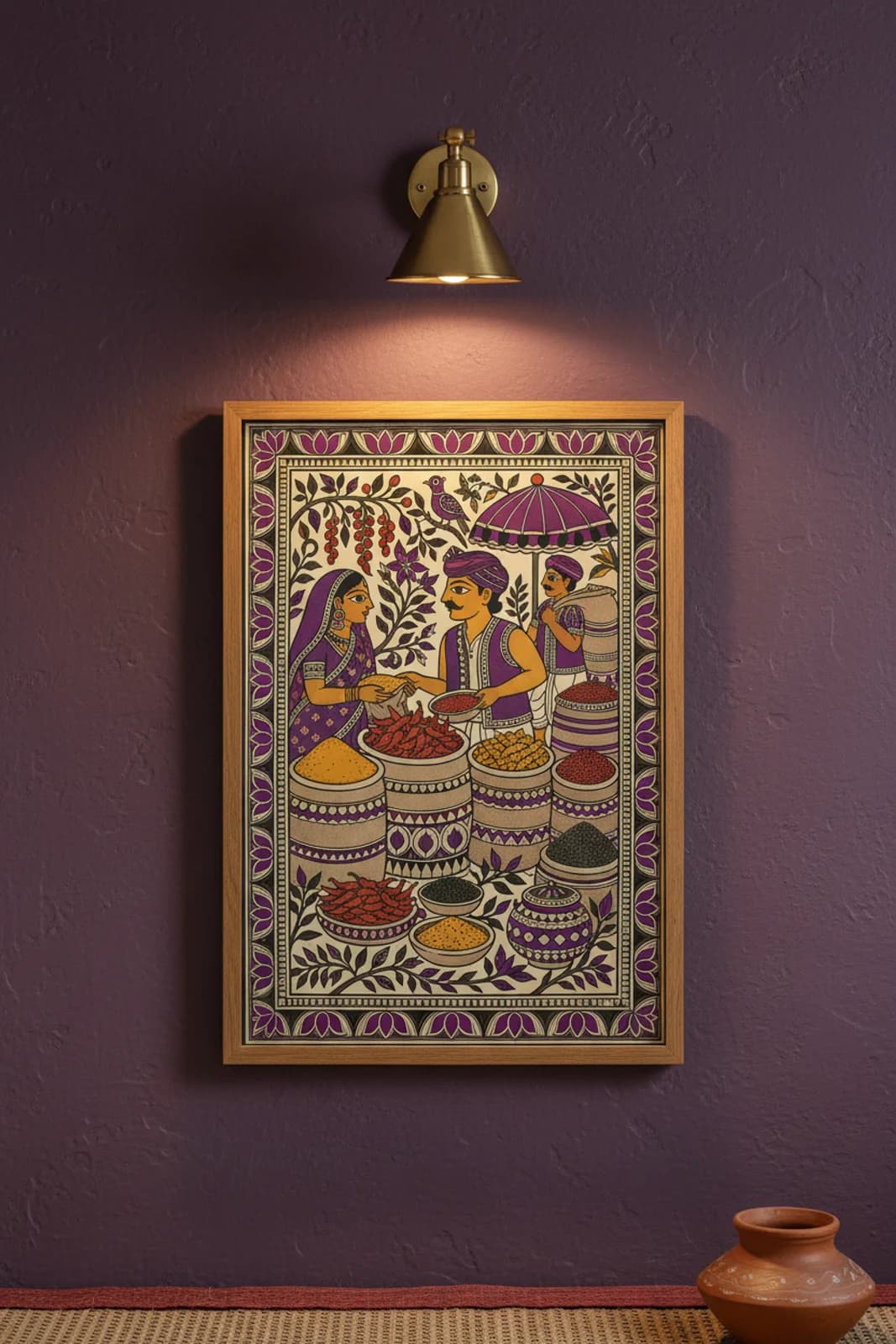
DESIGN BRIEF: The translation problem was market noise versus folk legibility — a Kerala spice lane photographed has twenty sacks, five scales, and signage in three scripts; Bharni Madhubani survives on three gestures and pigment-coded heaps. Asymmetric-narrative symmetry solves it: buyer left, seller centre, porter under umbrella right — one left-to-right read like a Kohbar procession band, while the four-sided lotus-triangle border keeps formal enclosure without turning the scene into a grid. We stacked cylindrical sacks as decorated folk drums with horizontal lotus and triangle bands so jute texture reads as pattern, not stock photography; turmeric yellow, vermillion chili, and lampblack peppercorn bowls become the colour keys that name the spices without typography. The flowering tree arching from upper left is deliberate Mithila canopy grammar — bird on branch, berry clusters, five-petaled blooms — anchoring a contemporary Malabar trade subject inside north Bihar nature vocabulary. What we dropped: scale weights, price boards, shop names. What we kept: the hand-off bowl, the cloth bag of haldi, the porter's shaded load, and border lotus cells that tie abundance symbolism back to classical Bharni harvest panels.
 WALLIMILIST