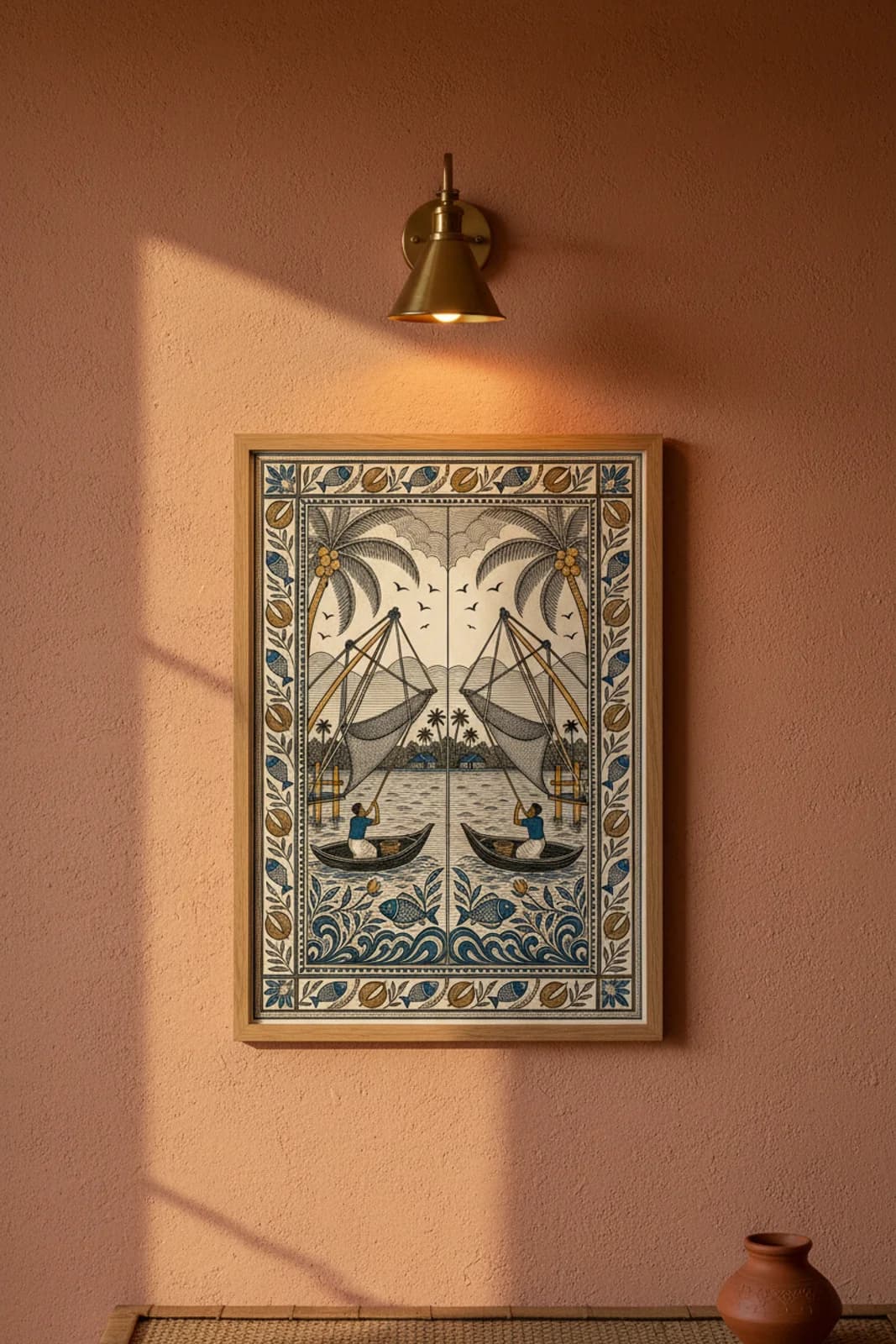
The brief was a translation problem across coast and tradition: how does a Kochi Chinese fishing net — cantilevered timber, counterweight rope, mesh that sags with tide — read inside Mithila line without looking like a tourism poster pasted on rice paper? Kachni gave the mesh answer. Parallel and cross-hatch strokes carry the net surface where Bharni flat fill would flatten the rig into a brown blob; ochre timber beams stay as bold folk solids so the engineering skeleton survives at poster scale. Twin-panel-mirror was the layout fix — one net alone would float decorative, but mirrored panels with a vertical centre seam give the Cheena vala pair the same bilateral grammar Kohbar walls use for facing fish and birds. What we simplified: harbour clutter, boat registration, facial detail. What we kept legible: rope pull posture, wicker catch basket, palm-and-hut shoreline, and the wave-fish register that ties a Malayali waterfront machine back to Mithila water-and-abundance symbolism. The coconut-and-fish border is not Kerala clip art — it re-anchors a contemporary coastal livelihood inside folk contour discipline.
 WALLIMILIST