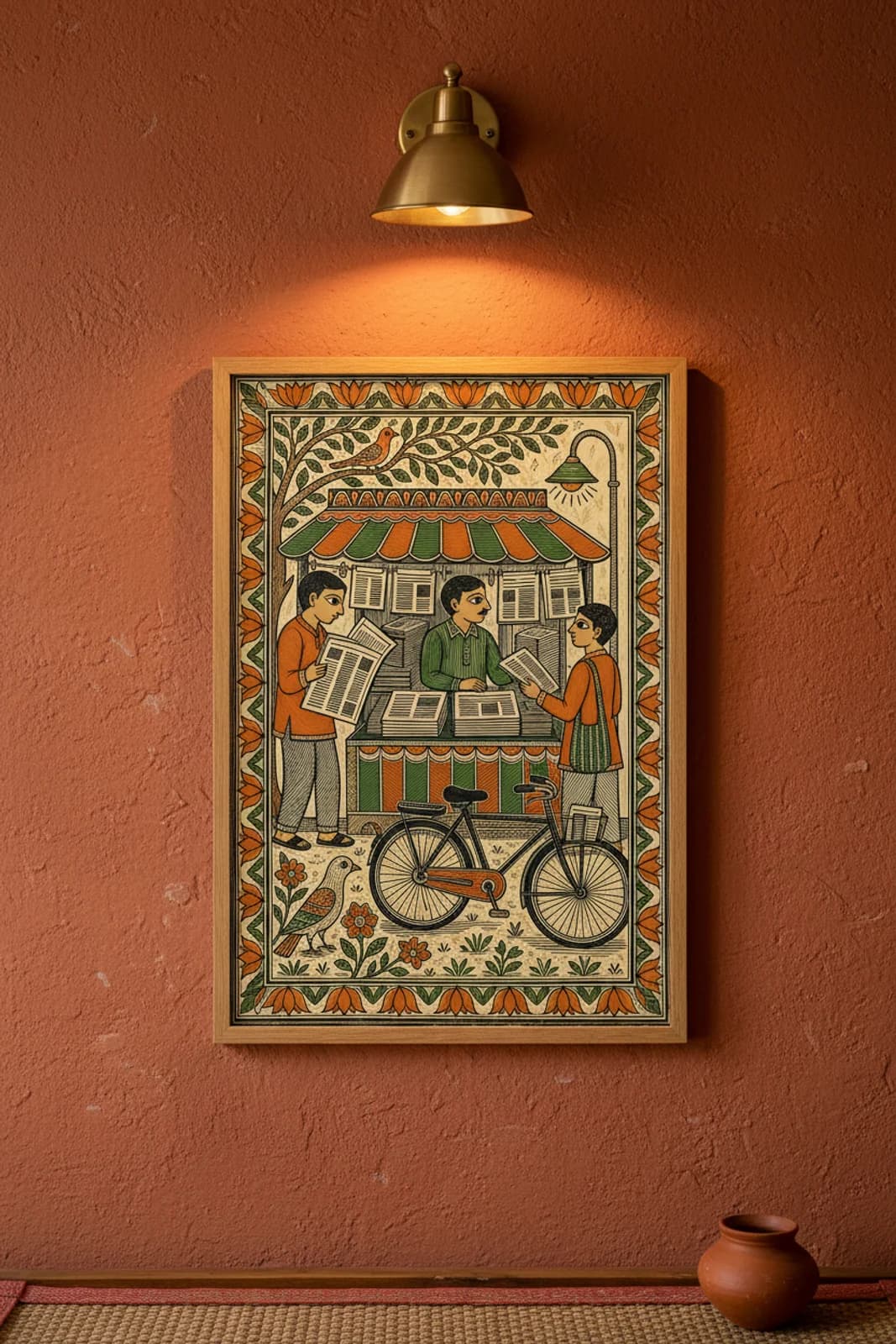
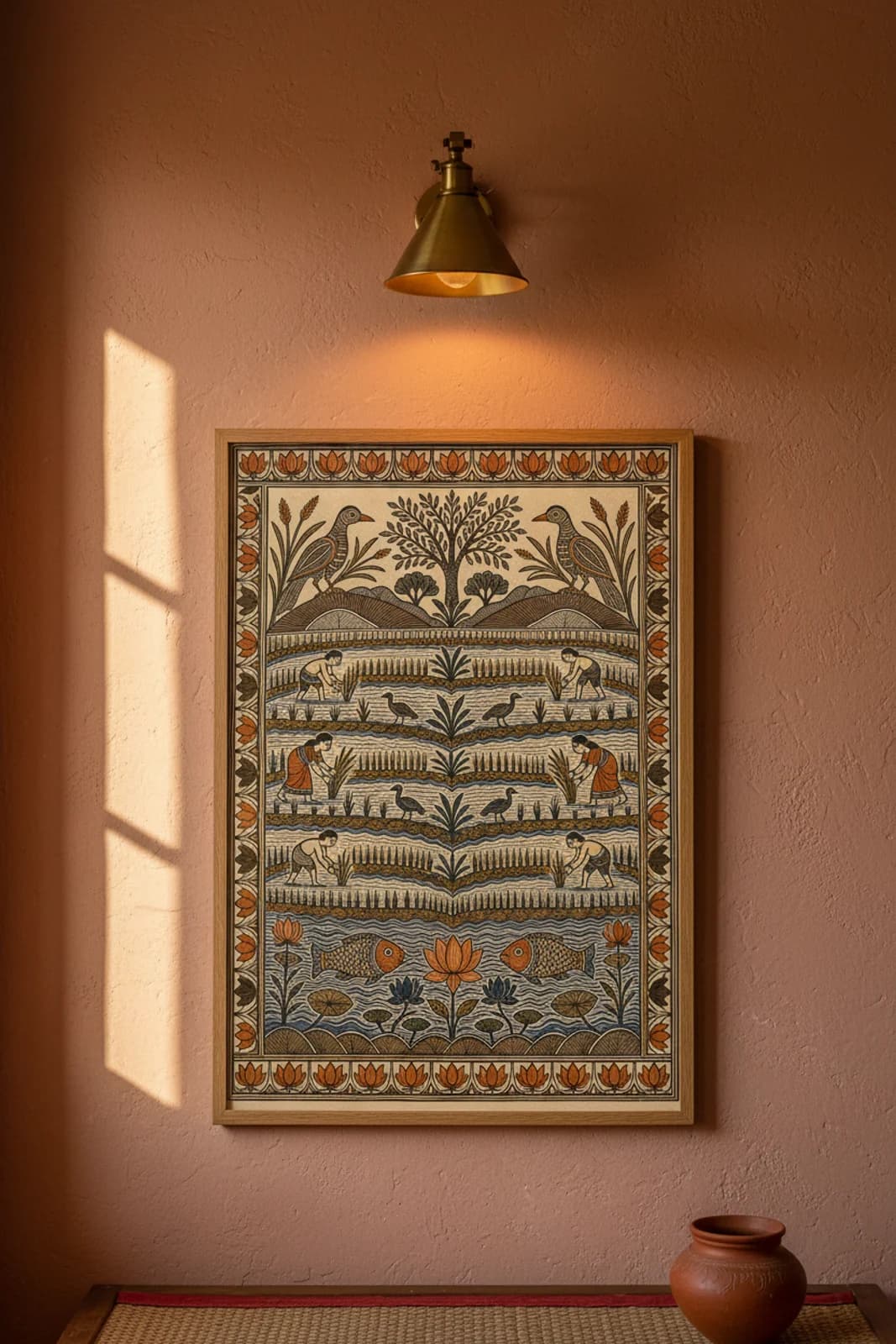
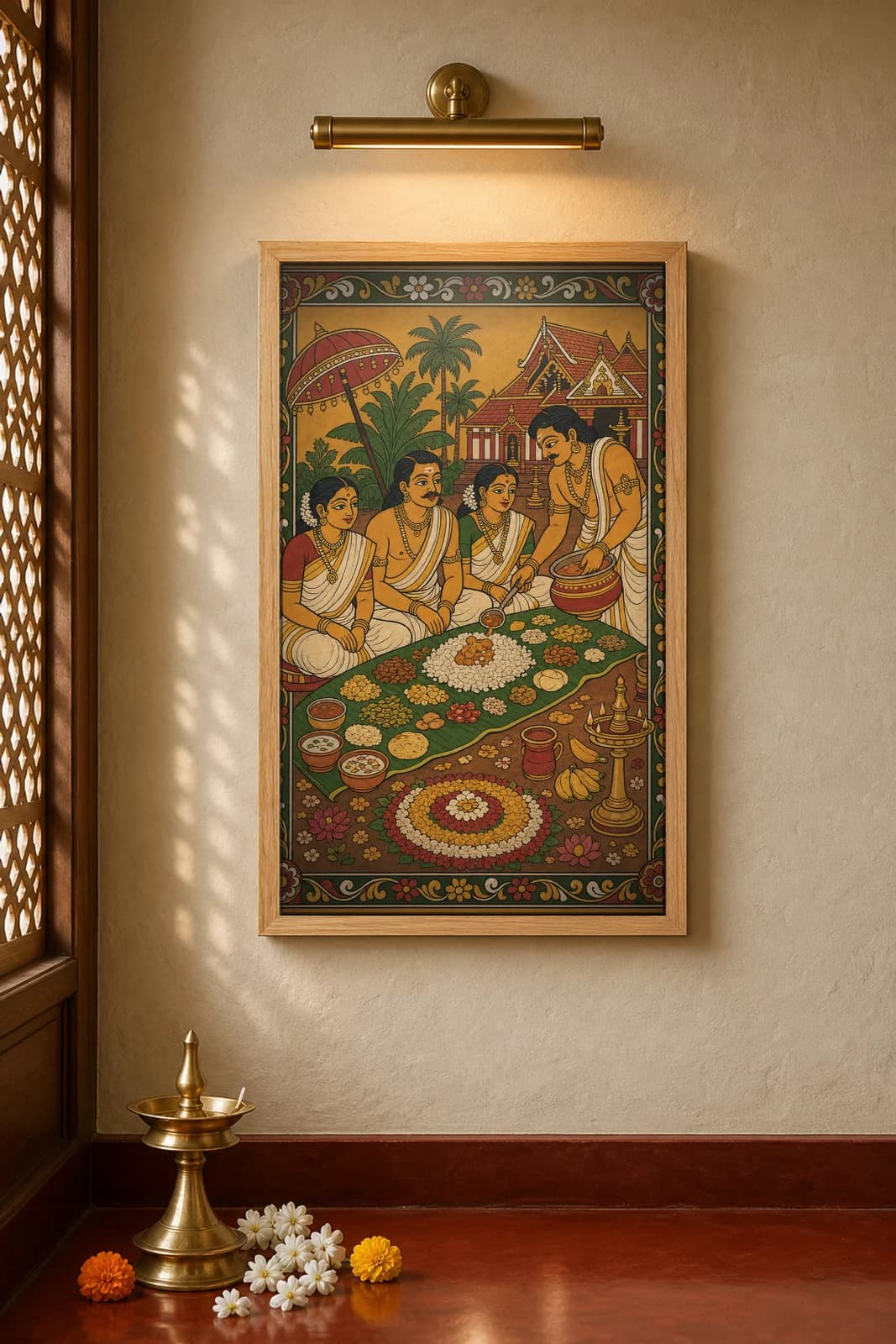
Brown Ochre — 3 museum-grade prints in this palette. The Onam sadya is the great vegetarian feast of Kerala's harvest festival, served on a fresh banana leaf and eaten by hand — rice with a long sequence of curries, pickles, pappadam and the sweet payasam, each in its proper place on the leaf. The picture is built in the idiom of bhitti chitra, Kerala's temple-mural tradition, which uses the panchavarna five-colour system — red, yellow, green, black and white over an ochre ground — in flat opaque fields bounded by a bold lamp-black outline, with the school's signature elongated lotus-shaped eyes. Kachni — from the Hindi word for fine line — is the Madhubani tradition associated with Kayastha women painters who built form through dense parallel hatching, cross-hatch, and stippling inside bold double black outlines, distinct from Brahmin Bharni flat colour floods and Dusadh Godna tattoo dot grammar. On classical walls Kachni rendered bamboo, fish scales, peacock feathers, and manuscript page fields; on paper it became the line discipline of villages like Ranti and Jitwarpur after the 1960s famine-era transfer from mud-wall ritual to market craft. Kachni — from the Hindi word for drawing or line work — is the Kayastha women's Madhubani tradition built on fine parallel hatching, stippling, and cross-hatching rather than Bharni's bold flat colour fills. Historically practiced with bamboo sticks and nib pens dipped in lampblack on cow-dung-washed handmade paper, Kachni panels often depict daily village life, nature, and ritual scenes with restrained pigment — commonly indigo and ochre accents on cream.