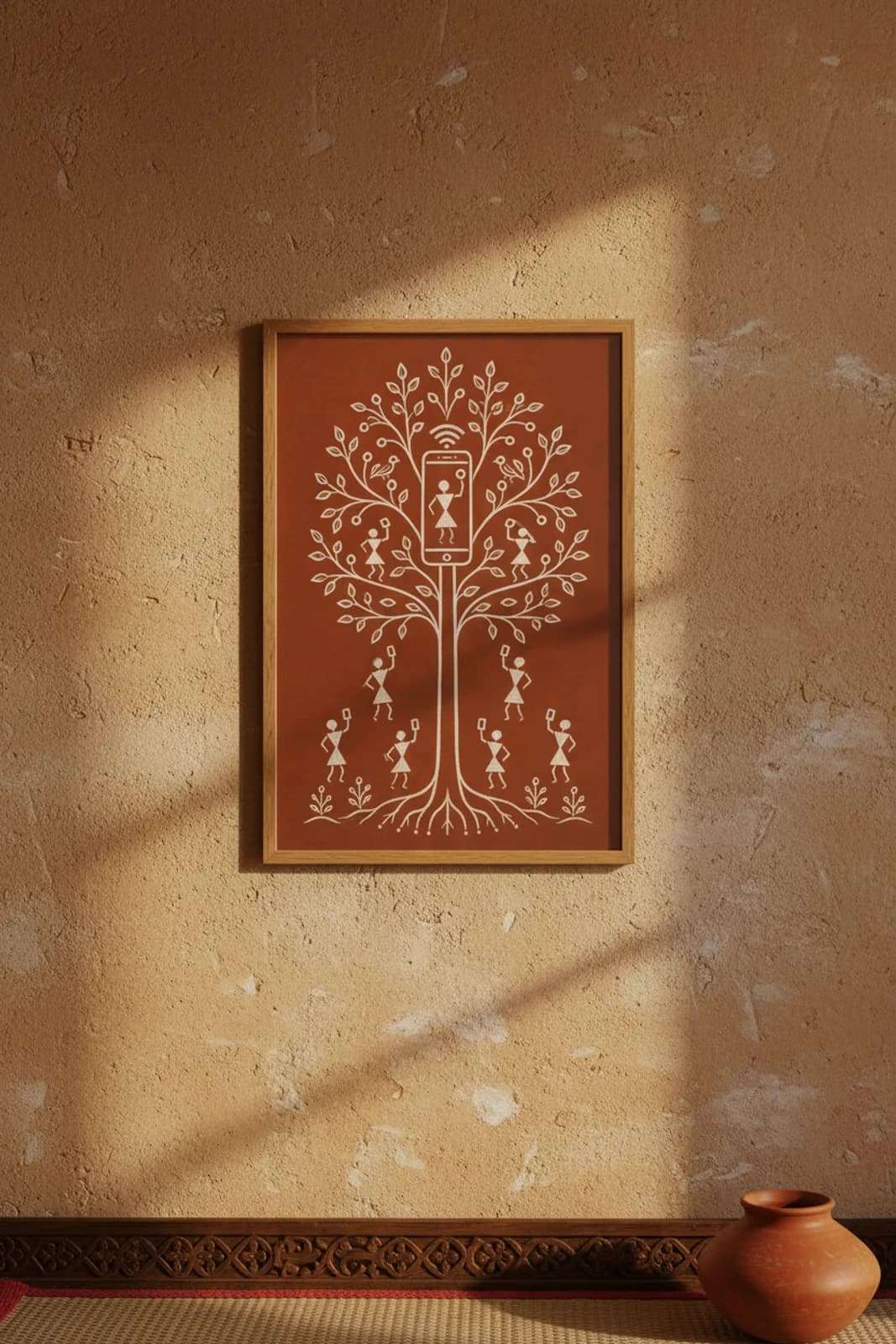
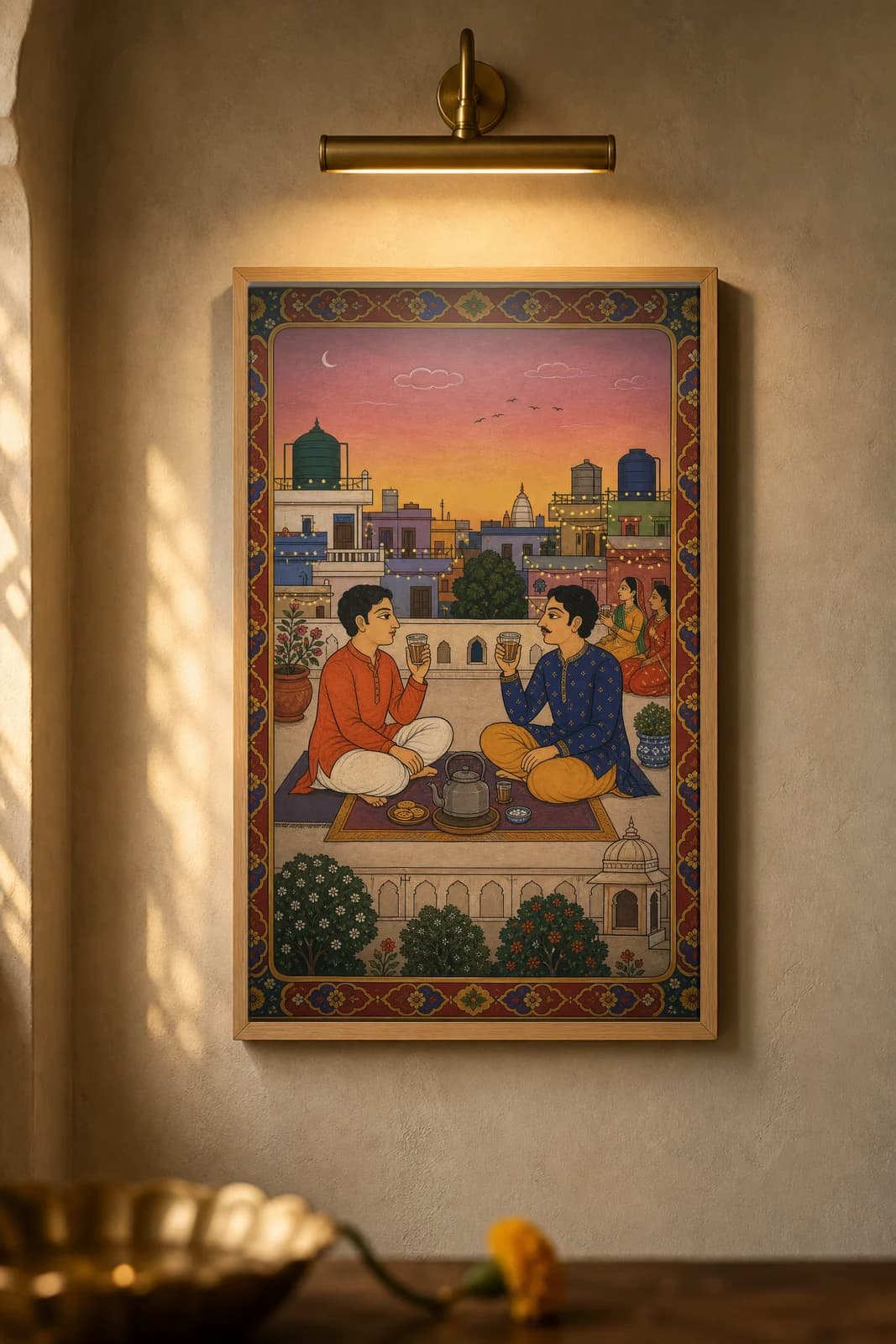
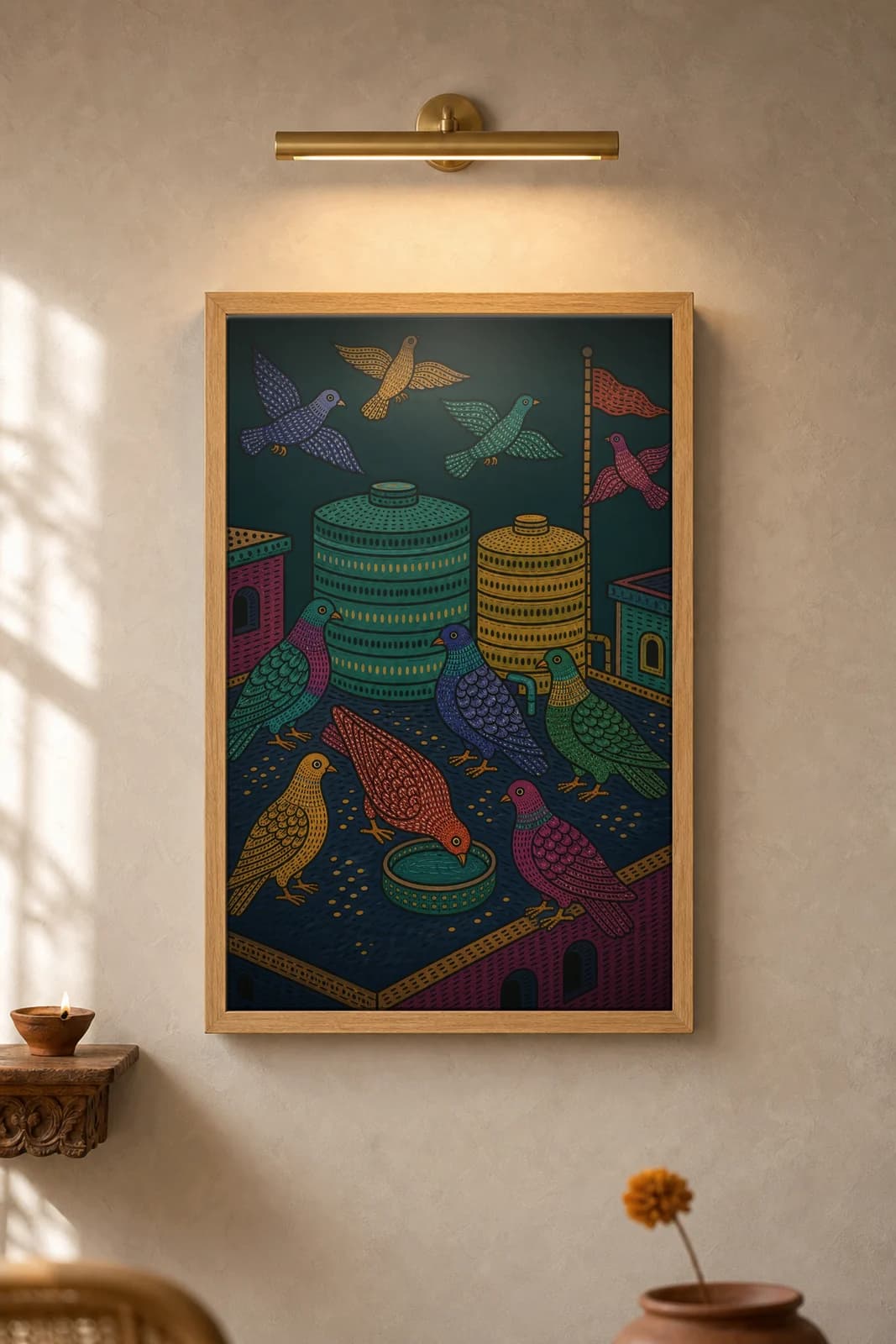
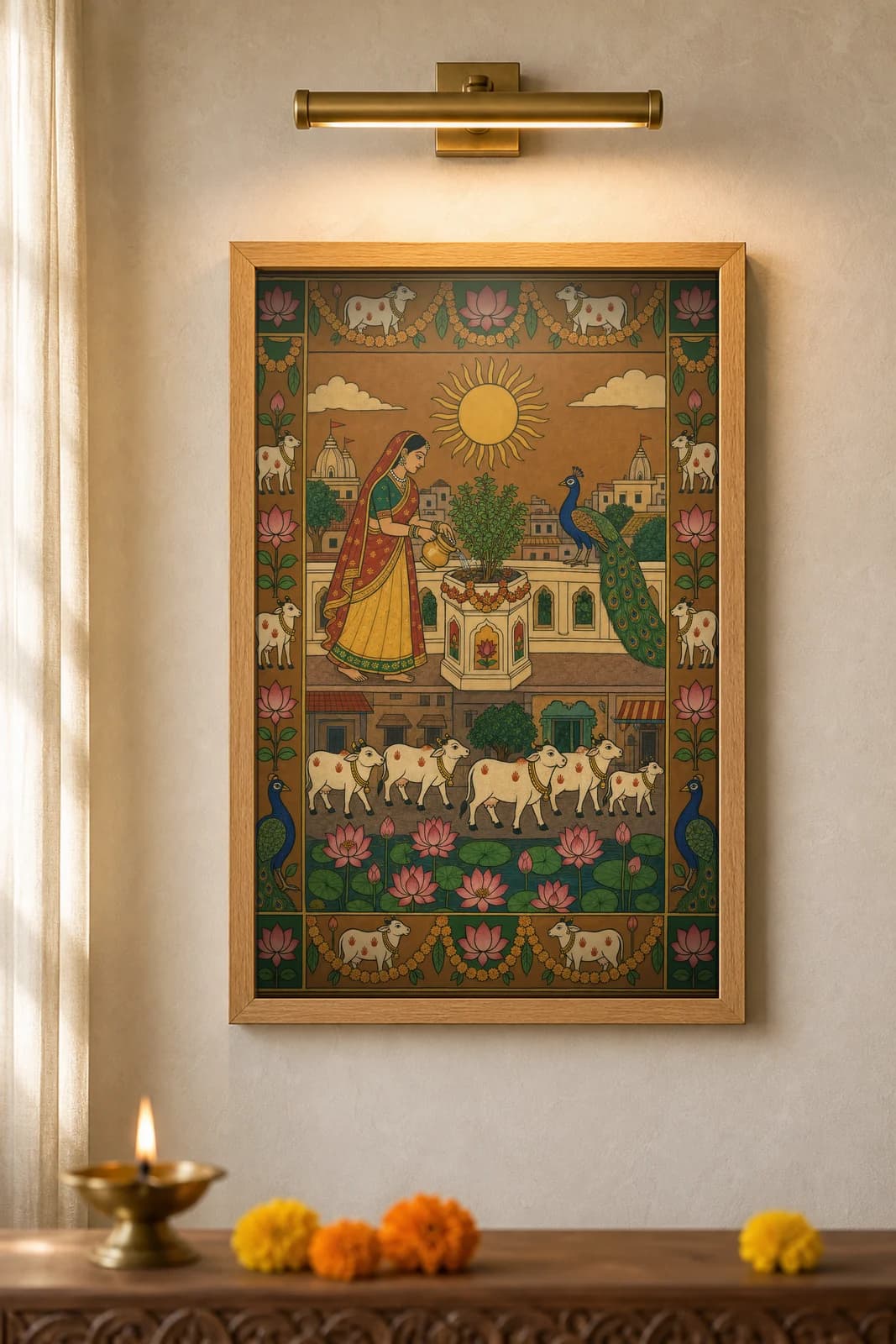
Balcony Nook — 4 museum-grade prints sized and toned for the room. Warli painting belongs to the Warli Adivasi community of the North Sahyadri, historically white rice-paste on geru mud walls where circle-canopy trees anchor forest and village scenes. Bangalore's identity as India's silicon corridor created a distinct digital-nature visual culture — banyan roots beside startup campuses, signal bars beside monsoon canopy. Gond painting comes from the Gond Adivasi communities of central India, with its best-known school formed by the Pradhan Gond of Patangarh and the wider Dindori region of Madhya Pradesh. The contemporary form is largely the legacy of Jangarh Singh Shyam (1962–2001), whose line-and-in-fill manner — every form bounded by a bold outline, then filled with rows of dots, dashes, commas and scales — became known as Jangarh Kalam and was carried on by his family and students. Tulsi (holy basil) is revered in Vaishnav households as a form of the goddess and a daily seva, watered and circled each morning — a homely devotion close to the Pushtimarg (Vallabh) spirit of seva centred on Shrinathji, the child-Krishna of the Nathdwara haveli-temple in Rajasthan. A pichhwai (literally 'that which hangs at the back') is the painted cloth hung behind the deity to set the scene; here its grammar frames a household ritual.