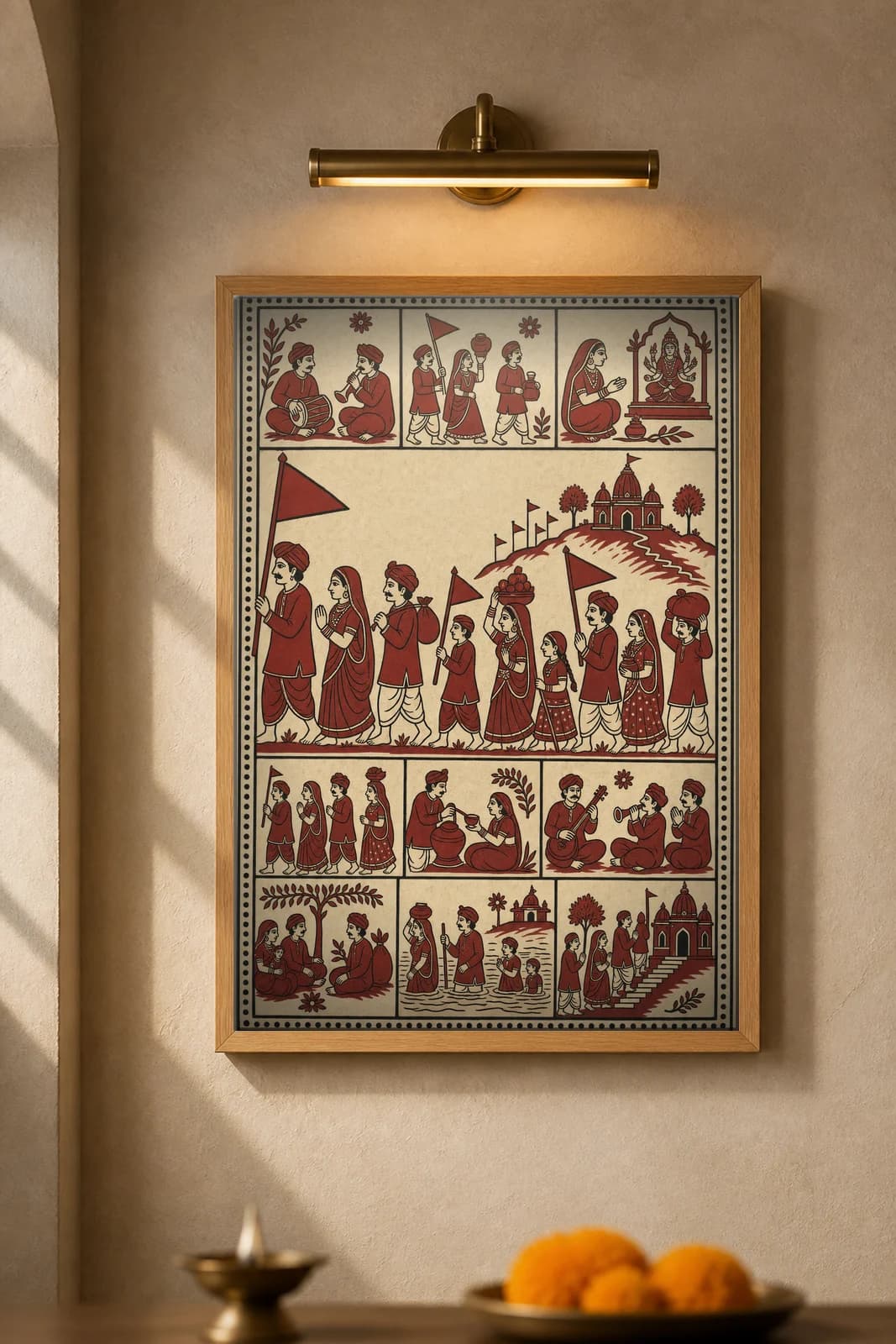
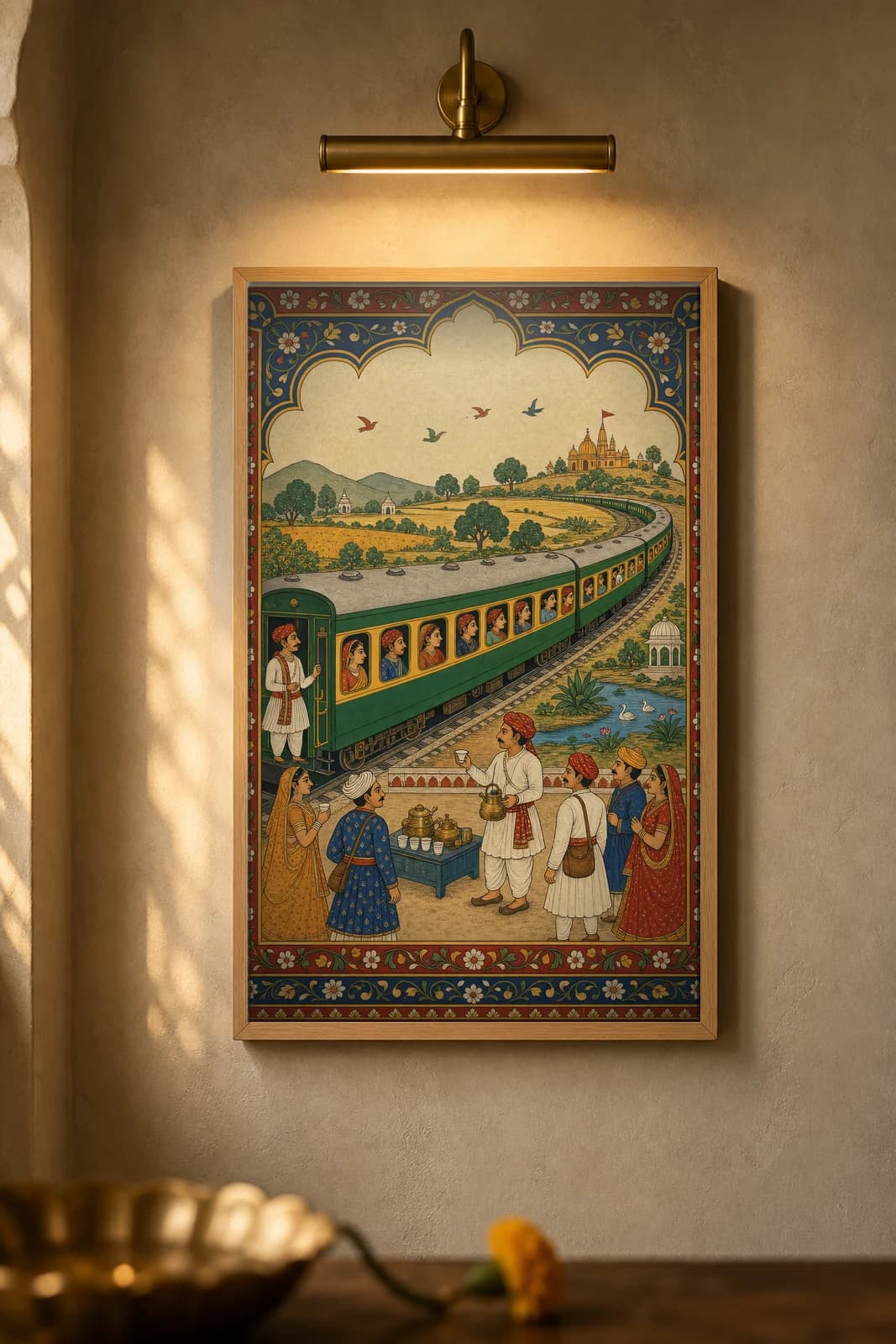
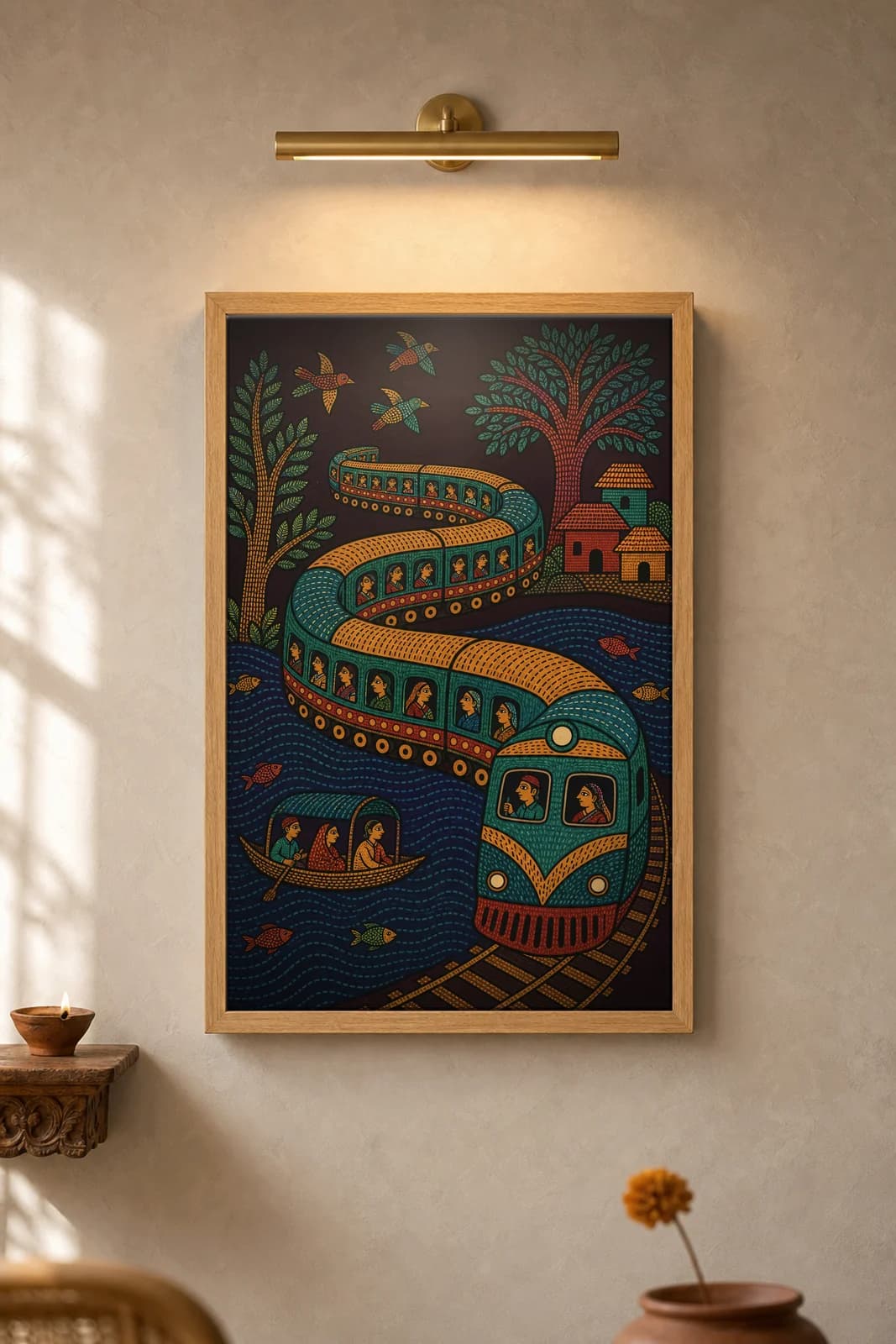
Journeying — 3 museum-grade prints that set the mood. Gond painting comes from the Gond Adivasi communities of central India, with its best-known school formed by the Pradhan Gond of Patangarh and the wider Dindori region of Madhya Pradesh. The contemporary form is largely the legacy of Jangarh Singh Shyam (1962–2001), whose distinctive line-and-in-fill manner — every form bounded by a bold outline, then filled with rows of dots, dashes, commas and scales — became known as Jangarh Kalam and was carried on by his family and students. Mata ni Pachedi means 'the cloth of the Mother Goddess' — a ritual shrine textile of the Vaghri / Devipujak ('worshippers of the Goddess') community of Ahmedabad, Gujarat, who, barred from temples, painted the Goddess on cloth to make their own portable shrine. Walking in procession to a hilltop shrine of the Mother — a madh, such as the famed Ashapura Mata na Madh in Kachchh — is a long-standing form of Gujarati Goddess devotion, undertaken on foot with flags and offerings. Amber and Jaipur are the refined Rajput court schools, known for ceremonial processions and durbar refinement. This contemporary fusion borrows that procession grammar for the railway journey, the great democratic ritual of Indian travel — the slow green express, the platform chai, the faces crowding the windows.