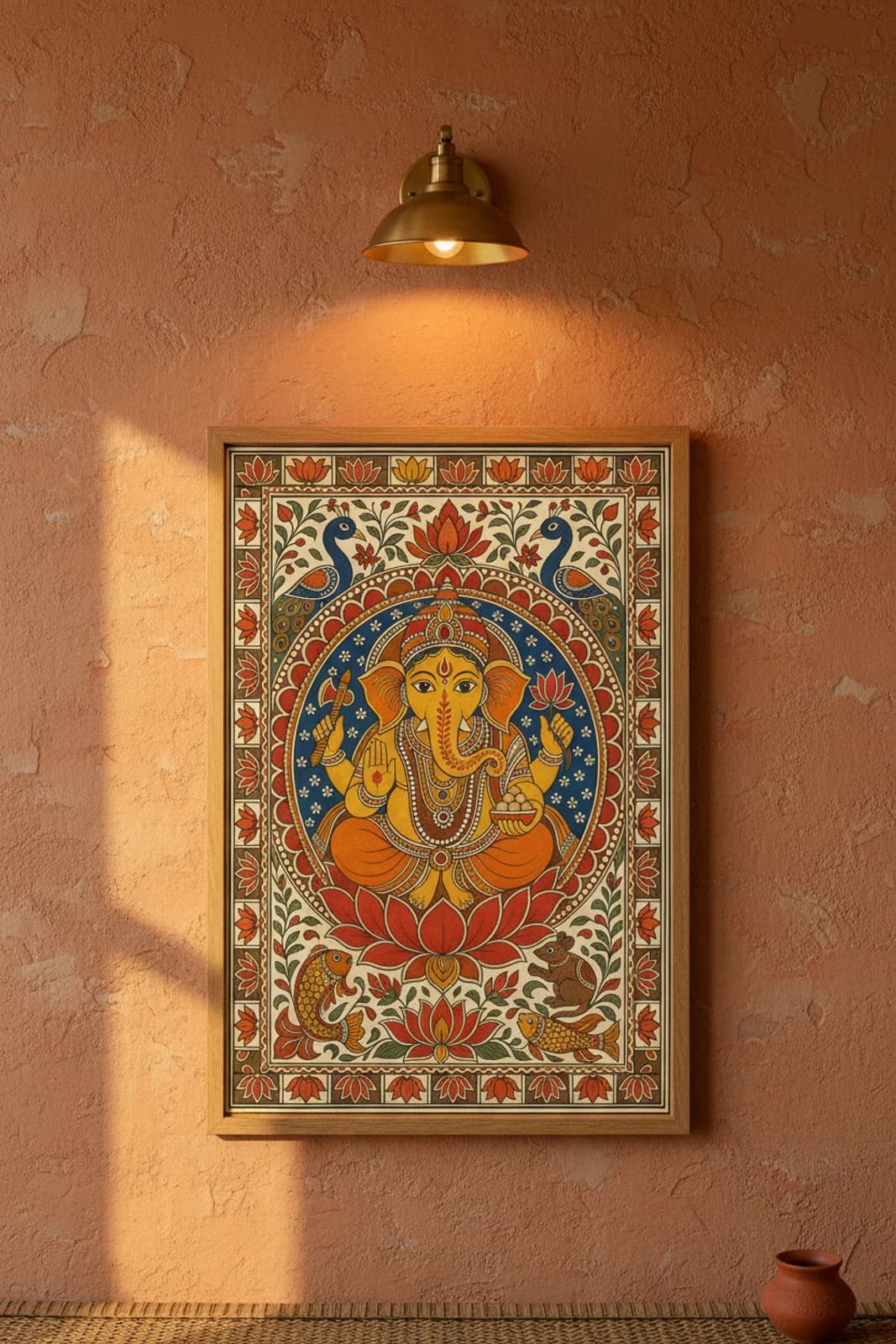
DESIGN BRIEF: The layout problem was devotional legibility without turning Ganesha into a sticker — a deity that reads at doorway distance inside Mithila grammar, not devotional-kit clip art. Bharni solved it: Brahmana colour-fill tradition carries the golden skin, vermillion crown, and lotus throne as flat pigment masses bounded by the same double black stroke used on wedding elephants and Kohbar fish. Central-medallion symmetry was non-negotiable for Vinayaka — unlike narrative procession panels, a blessing pose needs a still axis so the Abhaya mudra reads as address to the viewer. The circular halo borrows tantric night-sky convention — navy field with white blossom dots — but stays Bharni in execution: scalloped red rings and dot bands rather than yantra triangles. Peacocks crown the upper field facing a shared lotus because Mithila pairs beauty and auspicious threshold symbolism; matsya fish flank the lower register for fertility grammar; Mooshak waits lower right as vahana witness. The double lotus-panel border scales Kohbar wall enclosure to poster height — each square cell a miniature bloom so the frame never feels empty. What we kept ritual-accurate: four-arm attribute set, modak bowl, lotus seat, blessing gesture. What we compressed: narrative attendants and landscape — this is ceremony opener, not Mahabharata episode.
 WALLIMILIST