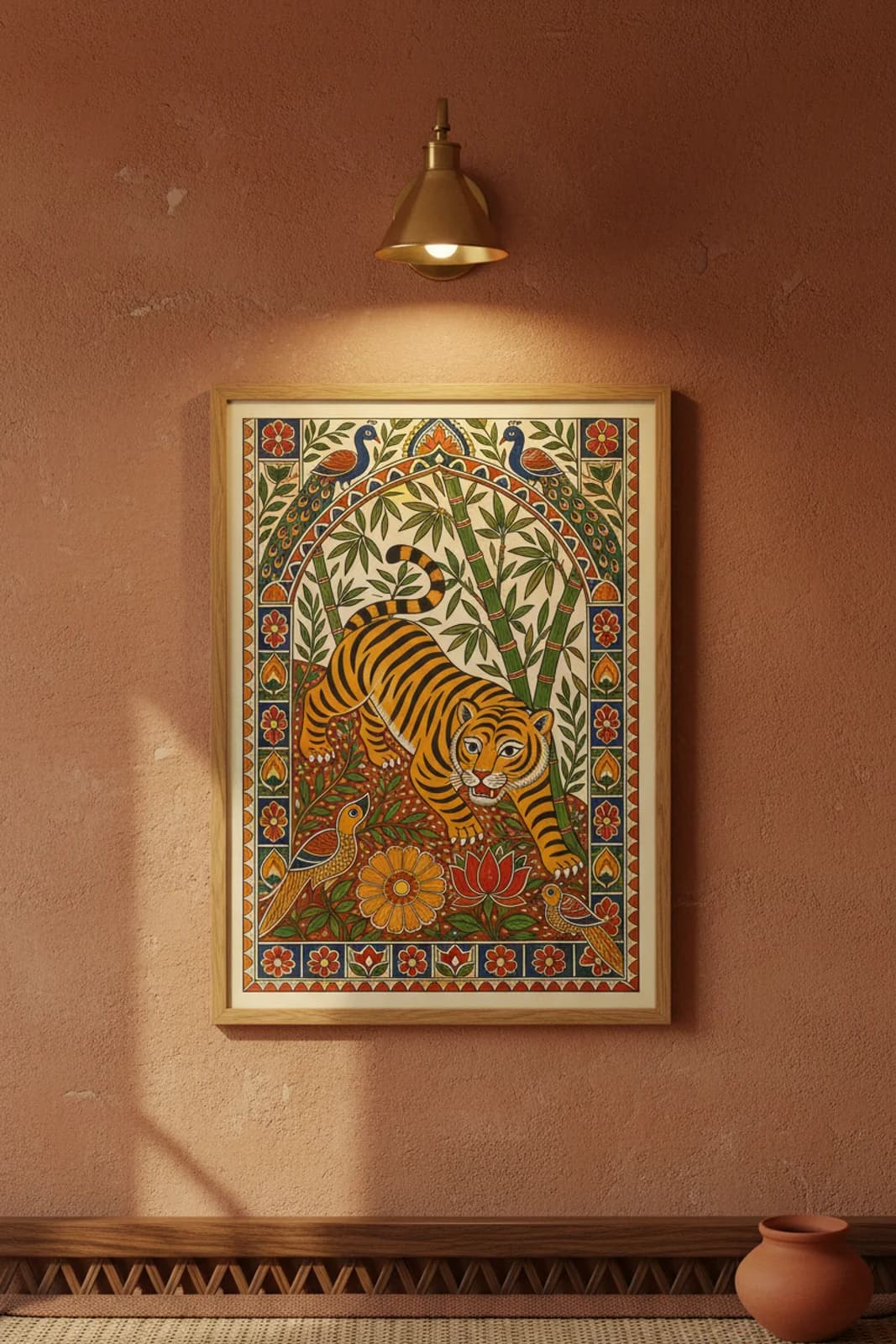
DESIGN BRIEF: Bharni Madhubani lives on flat colour courage — if the tiger reads as a generic safari clipart cat pasted over bamboo wallpaper, the whole panel forgets its Jitwarpur forest-guardian pedigree. Diagonal-flow symmetry solves that: tiger body, bamboo segments, and vine scrolls lean on a shared upper-left to lower-right axis so the forest feels like it moves through the frame rather than stacking motifs in static rows. I kept the hero bagh crouching with head turned toward the viewer because Mithila panels treat the tiger as threshold guardian — power and protection — not as distant wildlife documentary; the open mouth and forward gaze declare watchfulness the way village Bharni walls once framed stylised tigers among geometric foliage without importing Tantrik yantra narrative. Bamboo rises behind on purpose: male fertility and homestead shade symbolism from Kohbar grammar, translated here as vertical rhythm that counterpoints the diagonal tiger stride without breaking folk contour rules. The torana arch with paired peacocks crowning the scene borrows wedding-wall crown grammar — mor as beauty and rain messenger — while the square-panel indigo border anchors the dense interior so diagonal flow does not dissolve into edge chaos. Sunflower and lotus at the base bookend the forest floor the way threshold flowers bookend ritual walls; corner birds face inward toward the bagh as forest witnesses, not decorative afterthoughts.
 WALLIMILIST